





Read more detail on our methodology below.
Celestron NexStar 5SE Computerised Telescope
Best overall telescope

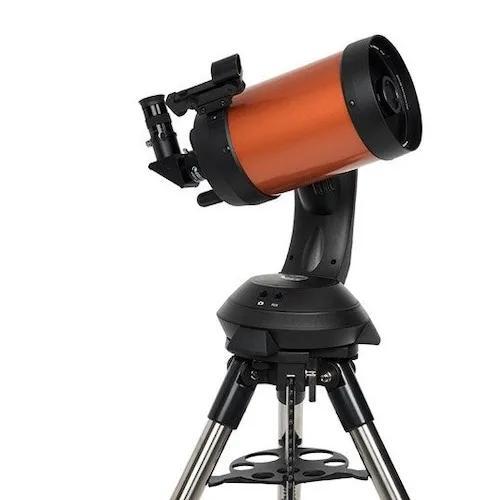
Image: Supplied/Finder
Pros
- Automatically locates and tracks 40,000 objects
- Easy to use
Cons
- Expensive
- Some buyers complain about poor-quality tech support
Buy now
The Celestron NexStar 5SE Computerised Telescope is our top choice for the best overall telescope. Boasting an average rating of 4.5 out of 5 stars from numerous satisfied customers. The NexStar 5SE is noted for its user-friendly set-up and performance that keeps users engaged, making the exploration of the cosmos accessible and enjoyable.
This computerised instrument features an automated Go-To mount and a database housing data for over 40,000 celestial bodies, revolutionising how users navigate the night sky.
Despite its notable features and high praise, the NexStar 5SE does come with a couple of drawbacks. Its premium features are reflected in its price, which may be prohibitive for some astronomy enthusiasts on a budget. Additionally, there have been instances of customers expressing dissatisfaction with the technical support provided by Celestron.
Nonetheless, the NexStar 5SE remains a high-performing, reliable choice for those seeking to delve deeper into the universe from their backyard.
Skywatcher Heritage 90 Virtuoso Tracking Telescope
Best telescope for beginners

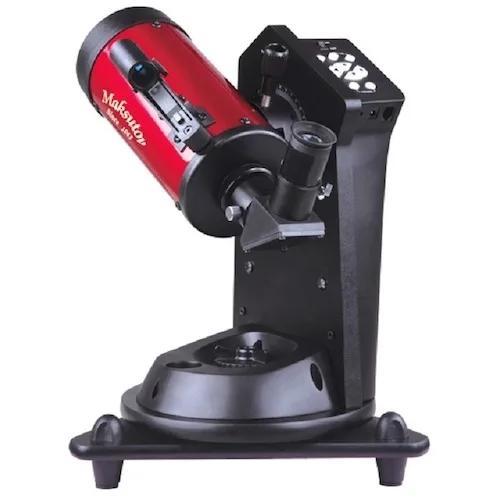
Image: Supplied/Finder
Pros
- Compact
- Great value for money
Cons
- Not suitable for extreme outdoor scenarios
- Set-up is a tiny bit difficult
Buy now
The Skywatcher Heritage 90 Virtuoso Tracking Telescope is a fantastic entry point for those new to stargazing. It has a rating of 4.3 out of 5 stars on Amazon.
This telescope features a formidable 90mm aperture Maksutov-Cassegrain design that gathers ample light for extraordinary views of brighter celestial objects. It benefits from a lightweight, portable design, ideal for those eager to explore different locations. The accompanying tabletop base ensures a stable viewing experience on any sturdy surface.
However, beginners might find the initial set-up and calibration challenging, albeit this is a common con for most high-quality telescopes. And while the telescope's portability is a significant advantage, it might not be suitable for more extreme outdoor conditions, requiring additional care in such scenarios.
Today's Skywatcher Heritage 90 Virtuoso Tracking Telescope deals



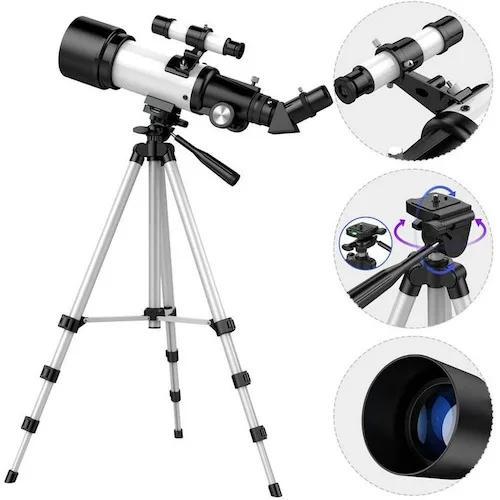
Image: Supplied/Finder
Pros
- Comes with a handy phone adapter for portability
- Easy to set up
Cons
- Not as sturdy as higher-end models
- Unsuitable for deep-space viewing
Buy now
The OYS 70mm Telescope is our pick for children interested in astronomy. With an impressive rating of 4.2 out of 5 stars on Amazon, its ease of set-up, user-friendly features and portability make it an ideal starter kit for young, aspiring astronomers.
Providing a magnification range from 20X to 44X, this telescope is ideally suited for observing the moon, planets and other celestial objects nearby in our solar system. The inclusion of a phone adapter is a wonderful addition, allowing kids to capture their exciting discoveries and share them with family.
However, while this telescope excels in numerous aspects, it does fall short in a few areas. Specifically, the OYS 70mm Telescope does not support deep-space viewing, limiting the range of astronomical exploration. Additionally, while advantageous for portability, the telescope's lightweight design may cause stability issues during windy conditions.
Sky-Watcher Quattro 200P
Best telescope for astrophotography

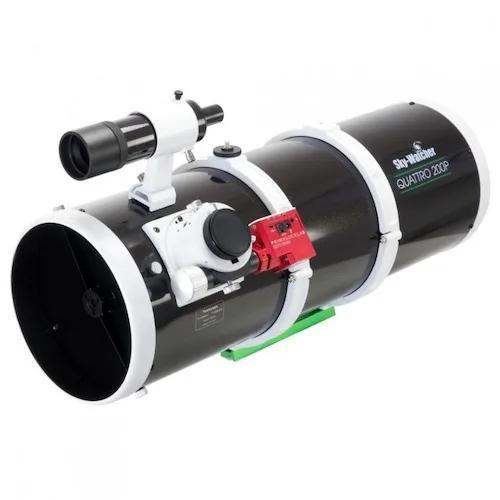
Image: Supplied/Finder
Pros
- Ensure sharp and clear viewing for celestial captures
- Sturdy build
Cons
- Not the most beginner-friendly
- Focal point is capped at 800
Buy now
With a rating of 4.8 out of 5 stars on Amazon, our team recommends the Sky-Watcher Quattro 200P as the best choice for astrophotography.
The telescope's fast f/4 optics offers unparalleled detail in considerably less exposure time, allowing users to capture the cosmos in all its grandeur. It also features a 2-inch dual-speed Crayford-style focuser, ensuring the sharpness and clarity of your celestial captures.
There is also an oversized secondary mirror that further enhances its performance, providing complete illumination for both APS-C and full-frame DSLRs without vignetting. The multiple knife-edge baffles also minimise stray light, improving your viewing or imaging experience.
But before purchasing the Quattro 200P, you need to consider a few possible cons. For instance, the maximum focal length is capped at 800, which could limit the reach for some deep-space objects. The 8x50 straight-through finderscope may take some getting used to for beginners.
Celestron NexStar 5SE Computerized Telescope
Best telescope for viewing planets and galaxies
Image: Supplied/Finder
Pros
- 40,000-celestial-object database
- Lets you view any 3 bright objects in minutes
Cons
- A bit heavy to move around
- Fork arm design has a learning curve
Buy now
We also selected the Celestron NexStar 5SE Computerized Telescope for viewing planets and galaxies. Rated at an impressive 4.5 stars on Amazon, this orange tube marvel leverages a 5-inch aperture to deliver stunning, light-capturing capabilities.
This telescope delivers spectacular views of the moon, planets and deep-sky objects like the Orion Nebula while maintaining a compact and relatively portable form factor. There is also a fully automated GoTo mount, which boasts a database of over 40,000 celestial objects that can automatically locate and track for you.
SkyAlign technology further adds to the telescope's ease of use, allowing even those unfamiliar with the night sky to align the telescope on any 3 bright objects in mere minutes.
However, it does have a few cons. For one, the unique single fork arm design may require some getting used to for those accustomed to conventional scopes. While the sturdy steel tripod is designed for easy transport and quick assembly, the components can be a bit heavy for extended periods.
Celestron Travel Scope (21035)
Best telescope under $250

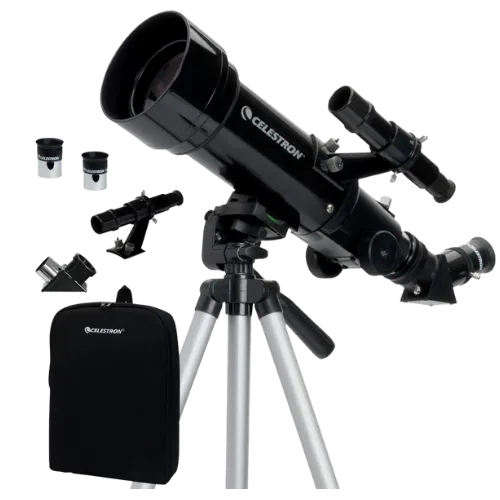
Image: Supplied/Finder
Pros
- Lightweight and portable
- Easy to set up and use
Cons
- Some complaints about wobbly tripod
- Some buyers would prefer more power
Buy now
If you're shopping for a telescope in this price range, the Meade Infinity we recommended for beginners higher up this page is well worth a look. But so too is the Celestron Travel Scope, which boasts an average score of 4.3 out of 5 stars from over 6,000 Amazon customer ratings and is our pick as the best telescope under $250.
This refractor telescope is available in 70mm and 80mm varieties. It comes with a backpack for easy transporting. It features fully coated glass optics to ensure clear images, while set-up is quick and easy without any tools required. A pair of eyepieces (20mm and 10mm) are included and the Celestron Travel Scope also comes with astronomy software with a 10,000-object database.
Today's Celestron Travel Scope (21035) deals
8% off Celestron Travel Scope (21035)
Save when you shop the best telescope online with these coupons:
Amazon
Telescopes and binoculars as low as $99.99
Save when you shop telescopes, binoculars, and monoculars at Amazon. Prices start at $99.99. While stocks last. T&Cs apply.
Temu
Up to 30% off binoculars for adults
Shop and get up to 30% off binoculars for adults at Temu while stocks last. T&Cs apply.
eBay Australia
Telescopes and monoculars as low as $15.20
Save on selected telescopes, binoculars and monoculars at eBay, with prices starting at $15.20. While stocks last. T&Cs apply.
Methodology


Why you can trust our picks
We started our search for the best telescopes by finding the highest-rated products on Amazon. We then compared those telescopes against others in the same category, considering factors like ease of use, key features, price and review comments. We also cross-referenced with expert reviews before deciding on our final top picks.
We considered telescopes from the following brands:
- AOMEKIE
- BNISE
- Celestron
- Discover with Dr. Cool
- ESSLNB
- Explore Scientific
- GazerOptics
- GeoSafari
- Gskyer
- Levenhuk
- MAXLAPTER
- MaxUSee
- Meade Instruments
- Merkmak
- Omega
- Orion
- OYS
- Quintessy
- Sky-Watcher
- SOLOMARK
- Stilnend
- SVBONY
- TELMU
- ToyerBee
- Vanstarry
- Zhumell
Frequently asked questions
What should I look for when buying a telescope?
When buying a telescope, consider your budget, the type of telescope you want and your observing needs. Set a budget and decide on the type of telescope (refracting, reflecting or catadioptric) that suits your interests. Think about what you'll be observing and consider the aperture for better image quality. Pay attention to the mount and tripod for stability and tracking accuracy.
What size telescope do I need for viewing planets?
The telescope size you need for viewing planets depends on several factors, including the planet's distance from Earth and its apparent size in the sky. Planets appear as relatively small objects in the night sky, so a larger-aperture telescope will provide better views. However, a smaller telescope may still provide satisfactory views if you'll mainly be observing bright planets like Mars or Jupiter.
What size telescope do I need to see Saturn's rings?
Saturn's rings are one of the most iconic features in our solar system and they can be seen with even a small telescope. However, a telescope with at least 6-inch (15cm) aperture is recommended to appreciate their intricate details and structure truly. With a larger aperture, you can see more detail and potentially even fainter rings, such as the Cassini Division. Good atmospheric conditions and proper viewing techniques can significantly enhance your viewing of Saturn's rings.
What size telescope do I need to see Mars?
Mars is a relatively small planet compared to Jupiter or Saturn, so a larger telescope is recommended for detailed observations. A telescope with at least 8-inch (20cm) aperture is recommended for clear views of Mars' surface features and possibly even its polar ice caps.
What size telescope do I need to see Venus?
Venus is the second planet from the Sun and the brightest in our night sky. Due to its relative proximity to Earth, Venus appears as a bright, featureless object in the night sky. Therefore, a smaller telescope with at least a 3-inch (7.5cm) aperture is sufficient for viewing Venus.
What size telescope do I need to see Jupiter?
Jupiter is the largest planet in our solar system and is known for its iconic swirling bands of clouds and its 4 Galilean moons. A telescope with at least a 6-inch (15cm) aperture is recommended to fully appreciate these features. With this size telescope, you can see Jupiter's cloud belts and potentially even its famous Great Red Spot.